Inheritance
- AD
- de novo mutations in 20-30% of patients
Etiology
- Mutation in tumor supressor gene PTCH (PTCH1 & PTCH2)
- Results in overactivation of Sonic HedgeHog (SHH) pathway, which has importante roles in neurologic and anterior-posterior axis development as well as hair follicle formation (that’s why vismodegib patients have alopecia)
- SUFU - more recently described gene, further down in the pathway
- High risk of medulloblastoma (up to 33%) and a high risk of meningioma post radiation
- Facial features are likely more subtle in individuals with an SUFU pathogenic variant
- No jaw cysts reported
- Resistence to Sonic Hedgehog inhibitors
- Normalmente temos 2 proteínas transmembranares (Ptch & Smo).
- Normally Ptch inhibits Smo.
- Smo activates GLI1&2 transcription factors, activate transcription of cellular growth genes
- Implicações clínica
- If Ptch is mutated, Smo is allowed to run free → cancar
- Sonic Hedgehog inhibitors (sonidegib or vismodegib) inhibit Smo → stop cancer
Sonic Hedgehog Pathway
Clinical presentation
- Skin
- Multiple basal cell hamartomas → associated with high risk of developping basal cell carcinoma
- Palmoplantar pits
- Small clusters pf basaloid cells, explains very focal defect in keratinization
- Comedones, epidermoid cysts, milia, molluscum pendulum, café-au-lait spots
- Extracutaneous (Bone, nerve, eye and endocrine)
- Maxillary cysts
- Bone signs
- Rib abnormalities (synostoses, bifidinites, partial agenesis)
- Vertebral and metacarpophalangeal malformations (shortness of the 4th metacarpal)
- Nervous system
- Clacification of the falx cerebri
- Meningiomas
- Medulloblastomas
- Agenesis of corpus callosum
- Eye
- Various ocular signs
- Endocrine
- Various sexual disorders
- Pseudohypoparathyroidism
Diagnostic criteria: 2 major e 1 minor ou 1 major e 3 minor ou identificação da mutação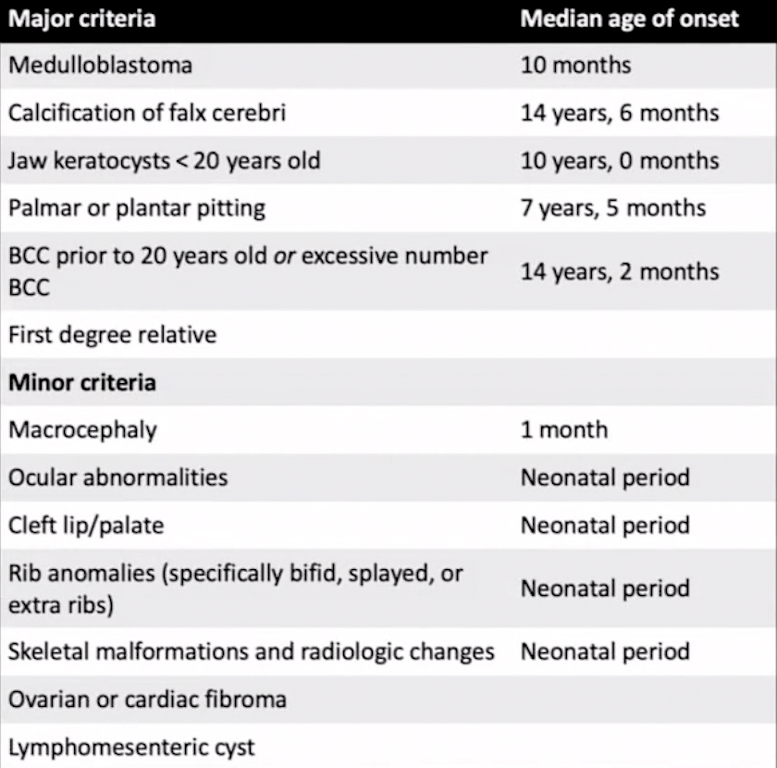
- Critérios major:
- >5 basaliomas
- Basalioma antes dos 30 anos de idade
- Calcificação lamelar da foice
- Queratocisto da mandíbula
- Pits palmo plantares
- Familiar de primeira ordem afetado
- Critérios minor
- Meduloblastoma na infância (tumor também dependentes da via Hedgehog)
- Quistos pleurais ou linfomesentéricos
- Macrocefalia
- Fenda do lábio ou palato
- Anomalias costais ou vertebrais
- Polidactilia preaxial ou pós axial
- Fibromas cardíacos ou ováricos
- Anomalias oculares
- Perls
- Palmar pits
- BCC may look like skin tags
- Calcification of the falx
- Bifid ribs
Exames complementares de diagnóstico
- Ressonância magnética na infância pelo risco de meduloblastoma se mutação SUFU
Treatment:
- topical imiquimod
- destructive lasers,
- Curettage and eletrocoagulation
- excision for nodular BCCs,
- Vismodegib, sonidegib
- Vismodegib inhibits Smo (doesn’t work with SUFU syndrome)
- Vismodegib patients have alopecia because sonic hedghog pathway is also important for hair development
- Also reduces size of maxillary cysts
- Radioterapia não aconselhada pelo risco carcinogénico de novos basaliomas
Seguimento
- Seguimento a cada 4-6 meses
 Made with Bullet